All machines Machines High-Speed Bottling and Canning Lines
Food and Packaging
High-Speed Bottling and Canning Lines
 4:19
4:19 A high speed line filling mineral water. Filmed and published by Krones AG. Plays from YouTube, nothing here is re-hosted.
What it does
A bottling line takes an empty or not yet existing container and delivers a sealed, labelled, dated, packed and palletised product without a human hand touching the product path. It is one continuous machine that happens to be spread over a building.
How it works
In a PET line the container is made on the spot: a preform, which looks like a thick test tube, is heated in an infrared oven and blown into a mold at high pressure to become a bottle seconds before it is filled. That blow moulder is usually blocked directly onto the filler so there is no conveyor between them and no chance for contamination. The filler is a rotating carousel where each valve rides with its bottle for most of a revolution, filling by weight, level or flow. Capping happens on the same block. Downstream the bottles are labelled, coded, grouped, shrink wrapped or packed into cases, and palletised. The whole line runs on a balance principle: every machine is deliberately sized faster than the filler except the filler itself, and accumulation tables between machines absorb short stoppages so the filler never has to stop.
The numbers
Modern high-speed water lines run in the tens of thousands of bottles an hour. Krones quotes its current benchmark block at 100,000 half-liter PET bottles an hour from a single wet end, and says that block splits the work across two modularized filling and closing units, using roughly 60 fewer filling valves than a single filler while delivering nearly 20 percent more output. Those are the maker’s figures, not measured ones.
Who uses one
Water, soft drink, beer, dairy, juice and liquid food producers, plus contract packers.
More food and packaging
See the whole category-
 4:52 Food and Packaging
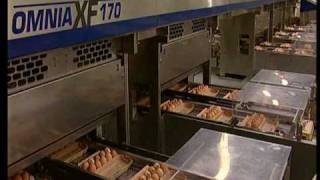
An egg grader sorting and packing at line speed
Eggs are handled by machine at rates that seem certain to end in disaster, weighed individually, candled for cracks and packed by grade. Nothing breaks. Egg grading is an object lesson in gentle handling at speed and it is fascinating to watch.
-
 4:30 Food and Packaging
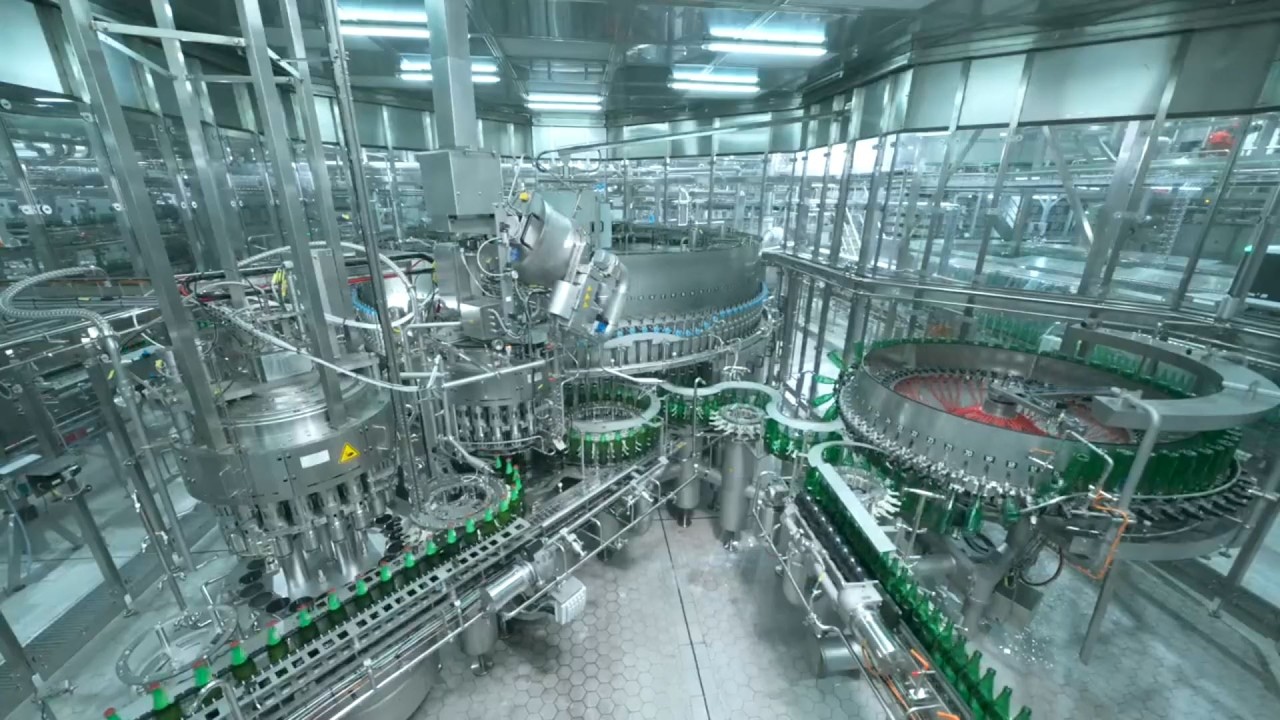
Building a greenfield brewery filling line
A greenfield brewery line from empty floor to full production, filmed as a project rather than as a machine demo. You see how filler, pasteuriser, packer and palletiser have to be balanced against each other or the whole line stalls. Rare and useful insight into how a line is actually specified.
-
 3:38 Food and Packaging
A journey through a carton filling machine
A journey through an aseptic carton filling machine, which forms, fills and seals a sterile package from a reel of laminate while never letting a single organism in. The sterile zone is maintained by peroxide and heat, not by a clean room. It is the reason milk can sit on a shelf unrefrigerated.
-
 2:24 Food and Packaging
A canning line filling and seaming
Empty cans arrive on an overhead air conveyor, drop into the filler, get seamed shut and leave in a solid moving wall of aluminum. Canning lines are the loudest and fastest thing in most beverage plants. Two and a half minutes of relentless throughput.
-
 2:22 Food and Packaging
A robotic case packer and palletizer at end of line
A robot erects the case, a second robot packs the product into it and a third stacks the finished cases on a pallet, all in one integrated end-of-line cell. FANUC films it running at production speed. This is the single most common automation project in food and beverage plants right now.
-
 2:13 Food and Packaging
A filler and capper built as one block
A filling block that combines rinsing, filling and capping on one frame so bottles never travel unprotected between machines. Blocking machines together removes conveyors, buffers and most of the contamination risk. Krones shows the valve carousel doing the work.
-
 1:46 Food and Packaging
A cobot erecting and packing cases
A cobot-based case erector and packer small enough to sit at the end of a single line, with no safety fence and a footprint a small plant can actually afford. Automation at this scale is a very different proposition to a full robotic cell. Under two minutes and immediately understandable.
Looking for one of these?
Fillers, cappers, labelers, packers and palletizers. APE buys and sells complete packaging lines and individual machines.
American Plant & Equipment has been buying and selling industrial machinery out of Roebuck, South Carolina since 1975, with 97,000 machines in inventory. Tell us the process you need to run and we will go and find the machine, or we will move the one you are finished with.
Prefer to talk? Call (864) 574-0404 or email sales@americanplantandequipment.com.