All machines Precision
Precision
Five-axis, wire EDM, gear grinding and machining measured in microns.
Want the mechanism, not just the footage?
We wrote a full explainer for this category: Large Gear Grinding and Hobbing. What the machine does, how it works, the numbers that matter and who buys one.
16 films
-
 9:36 Precision
How impossibly thin cuts are made
Steve Mold explains how a wire thinner than a human hair, carrying sparks rather than a cutting edge, slices through hardened steel with a kerf you can barely see. Nothing touches the workpiece, so there is no cutting force and no distortion. Once you understand spark erosion you cannot look at a die or a punch the same way again.
-
 17:29 Precision
Inside the plant that builds coordinate measuring machines
A tour of ZEISS metrology showing how a coordinate measuring machine proves a part is what the drawing says it is. Air bearings, granite bases and temperature-controlled rooms exist because at these tolerances your body heat is a measurement error. Without machines like this, precision manufacturing has no way to know it succeeded.
-
 15:08 Precision
Machining a watch gear
Cutting a watch gear means getting tooth form, concentricity and finish right on a part the size of a shirt button. Fifteen minutes of setup, cutting and measuring, all of it filmed properly. It is a masterclass in how much thought sits behind a part most people never see.
-
 12:21 Precision
Millions of tiny precision parts, made in Switzerland
Inside a Swiss shop producing millions of parts a year on rows of sliding headstock lathes, most of them running unattended. The parts are tiny, the tolerances are brutal and the volumes are enormous. It shows the economic argument for automation as clearly as the technical one.
-
 11:46 Precision
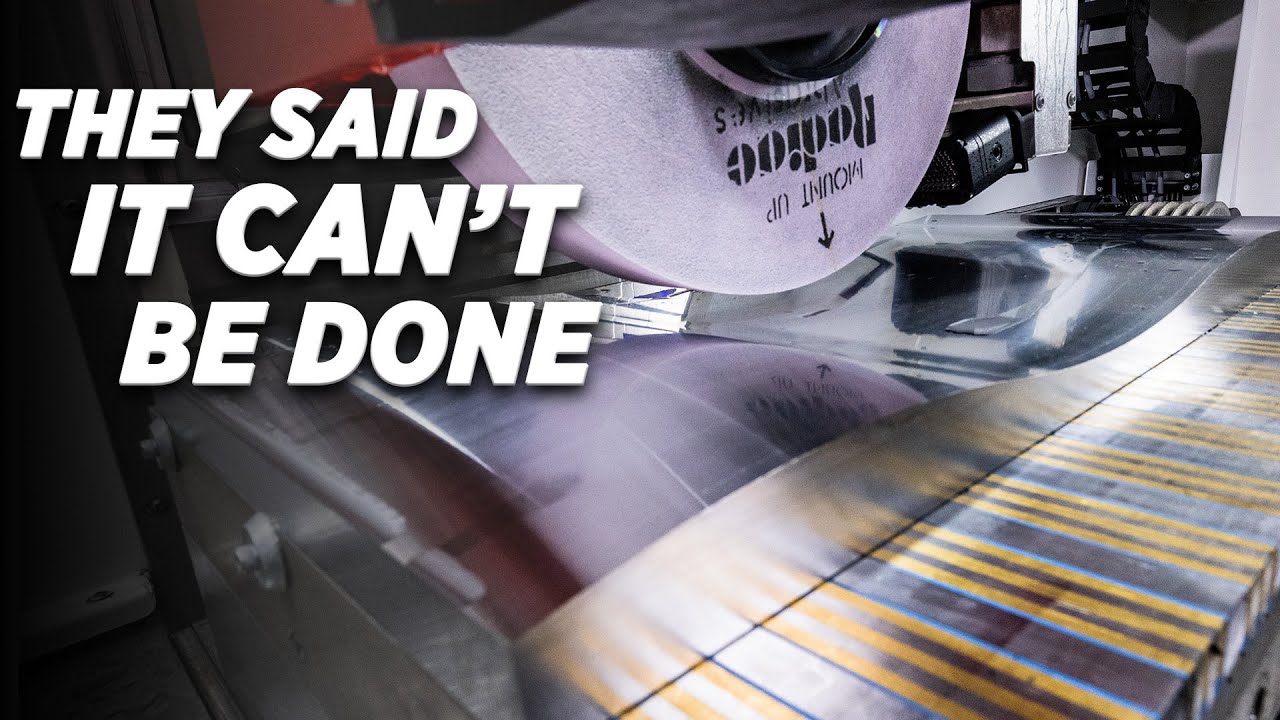
The part the shop was told could not be machined
Titan takes on a part that other shops turned down, then shows the fixturing, the toolpath decisions and the moments where it nearly goes wrong. This is 5-axis machining as problem solving rather than as a highlight reel. The finished part is genuinely beautiful.
-
 10:09 Precision
What a wire EDM machine actually does
Practical Machinist walks through what a wire EDM actually does, why the dielectric matters, and where it beats milling outright. Ten minutes, no hype, aimed at people who might buy one. A useful counterweight to the pure eye-candy clips.
-
 4:33 Precision
Machining a 0.6 mm screw
A screw 0.6 mm across, turned from bar stock on a lathe, with a slot and a head you need a microscope to appreciate. Chronova films it close enough that you can watch the chip curl. Watchmaking is where machining stops being manufacturing and becomes something closer to surgery.
-
 4:16 Precision
A gear hobbing machine cutting a very large gear
A hobbing machine cutting a gear several meters across, the hob and the blank rotating in a fixed ratio so the tooth form generates itself out of the geometry. Liebherr shows the chip load and the sheer mass of the setup. Watching a gear appear from a plain disc is oddly hypnotic.
-
 3:45 Precision
Grinding a bevel gear
Bevel gear grinding with a ceramic abrasive wheel, filmed close enough to see the sparks leave the flank. Bevel gears carry torque around a corner, which makes their geometry far harder than a spur gear. Klingelnberg is one of a handful of companies in the world that can build a machine to do this.
-
 2:54 Precision
Wire EDM cutting a puzzle cube that fits without a gap
A puzzle cube cut so precisely on a wire EDM that the pieces fall apart only when you want them to, and reassemble into a block with no visible seam. Tolerances in this class run to a few microns. It is the most tactile demonstration of precision on this entire list.
-
 2:18 Precision
A six spindle lathe turning parts in parallel
A six-spindle CNC multispindle lathe is effectively six machines sharing one bar feed, indexing so that every station cuts at once. Finished parts drop out at a rate a single-spindle machine cannot approach. INDEX shows the drum indexing and the tooling crowding in from every direction.
-
 2:07 Precision
Micro assembly under a microscope
Micro assembly means placing components measured in microns, repeatedly, without touching anything else. SmarAct uses piezo-driven stages and vision to build optical and photonic assemblies that human hands could never manage. The motion is so small and so fast it barely reads as movement.
-
 1:08 Precision
A Swiss-type lathe running nine axes at once
A short, clean look at a Mazak Swiss-type turning center working through a small complex part with multiple tools engaged at once. Mazak films their own machine without music or drama. Good for a feed because it reads instantly at thumbnail size.
-
 1:05 Precision
A Swiss-type lathe cutting a watchmaking screw
The Tornos SwissNano is a sliding headstock lathe built specifically for the watch industry, and here it turns a screw of a size that is hard to photograph. The guide bushing supports the bar right at the cut, which is why parts this slender do not deflect. Sixty-five seconds, no talking, all machine.
-
 1:05 Precision
Three small robots assembling electronics in a tight cell
Three tiny six-axis robots working shoulder to shoulder in a cell smaller than a desk, assembling electronics in a space where a normal industrial arm would not fit. Small robots open up applications that were previously manual by default. It is a good reminder that automation is not only about size.
-
 0:44 Precision
Grinding machines for gears taller than a person
Forty-five seconds of a Gleason machine grinding a gear big enough to sit in, holding a tooth profile that will run quietly under load for decades. Large gear grinding is one of the least glamorous and most demanding processes in metalworking. Wind turbine and mining gearboxes live or die on it.