All machines Machines Robotic Palletizing and Handling Cells
Robotics and Factory Automation
Robotic Palletizing and Handling Cells
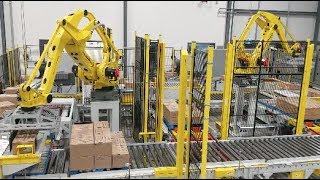 2:12
2:12 Multi-line robotic palletizing and stretch wrapping. Filmed and published by FANUC America Corporation. Plays from YouTube, nothing here is re-hosted.
What it does
A palletizing cell is a robot arm, a gripper, a pallet position, a conveyor feeding it and a fence with an interlocked gate. It takes cases, bags, trays or bundles off the end of a packaging line and stacks them onto a pallet in a pattern that will survive a truck. The same cell shape, with a different gripper and a different program, does machine tending, case packing, depalletizing and order building.
How it works
The line pushes a case up to a stop. The robot picks it with a vacuum head, a clamp or a fork gripper depending on what the case is, then places it on the pallet at a taught position. A pattern file holds the layer layout, the number of layers and the interlocking, so a change of product is a change of file rather than a change of hardware. A slip sheet dispenser or a pallet magazine feeds empties in. Vision is added when the incoming stream is mixed rather than sorted, because then the robot has to work out what it is looking at before it can decide where to put it. Safety is either a fence with an interlocked gate or, on a collaborative cell, force limits and a scanner that slows the arm as a person approaches.
The numbers
Payload and reach set what a cell can do. Palletizing arms are commonly specified from about 50 kg to 700 kg payload with reach in the 2 to 3.5 meter range, which is what puts the top of a full pallet inside the working envelope. Cycle rates depend far more on the gripper and the pattern than on the robot: a single case pick is often quoted around 10 to 20 picks a minute, and a layer gripper that lifts a whole layer at once changes the arithmetic completely. Makers quote their own figures under their own test conditions, so treat a headline rate as a starting point for a real cycle study.
Who uses one
Food and beverage, packaging converters, building products, chemicals, pet food, warehousing and third party logistics. It is the single most common first robot in a plant, because the work is repetitive, the load is heavy and the pattern rarely changes.
More robotics and factory automation
See the whole category-
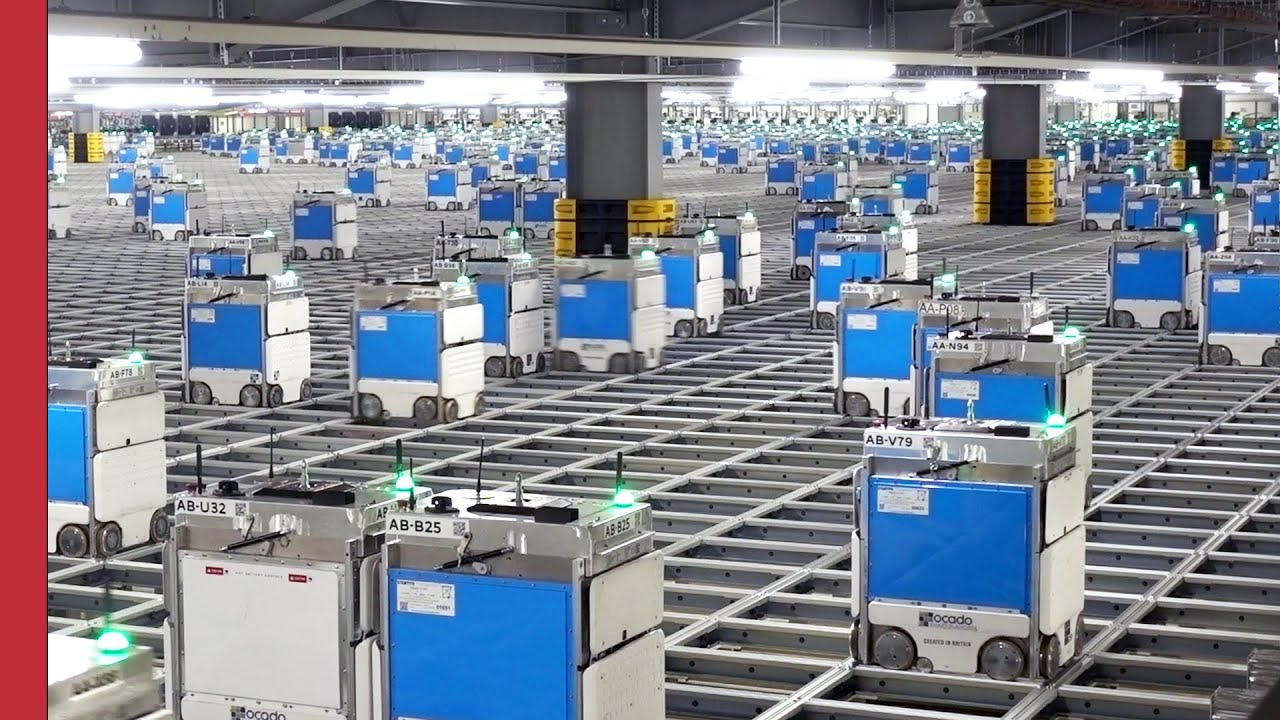 5:08 Robotics and Factory Automation
How many robots it takes to run a grocery store
Thousands of wheeled robots swarm across a grid the size of a football field, closing on each other at speed and missing by centimetres because a central brain schedules every move in advance. A grocery order that a person would walk two miles to pick is assembled in minutes. It is the clearest explanation on the internet of what goods-to-person automation actually looks like at full scale.
-
 13:52 Robotics and Factory Automation
A Mercedes body shop where robots build the car
Fourteen minutes inside a Mercedes body shop where sheet metal is welded, glued and handed between robots without a person in frame. Cells pass car bodies to each other like a relay team. KUKA published this as a capability film and it remains one of the most complete looks at a modern automotive body shop anywhere online.
-
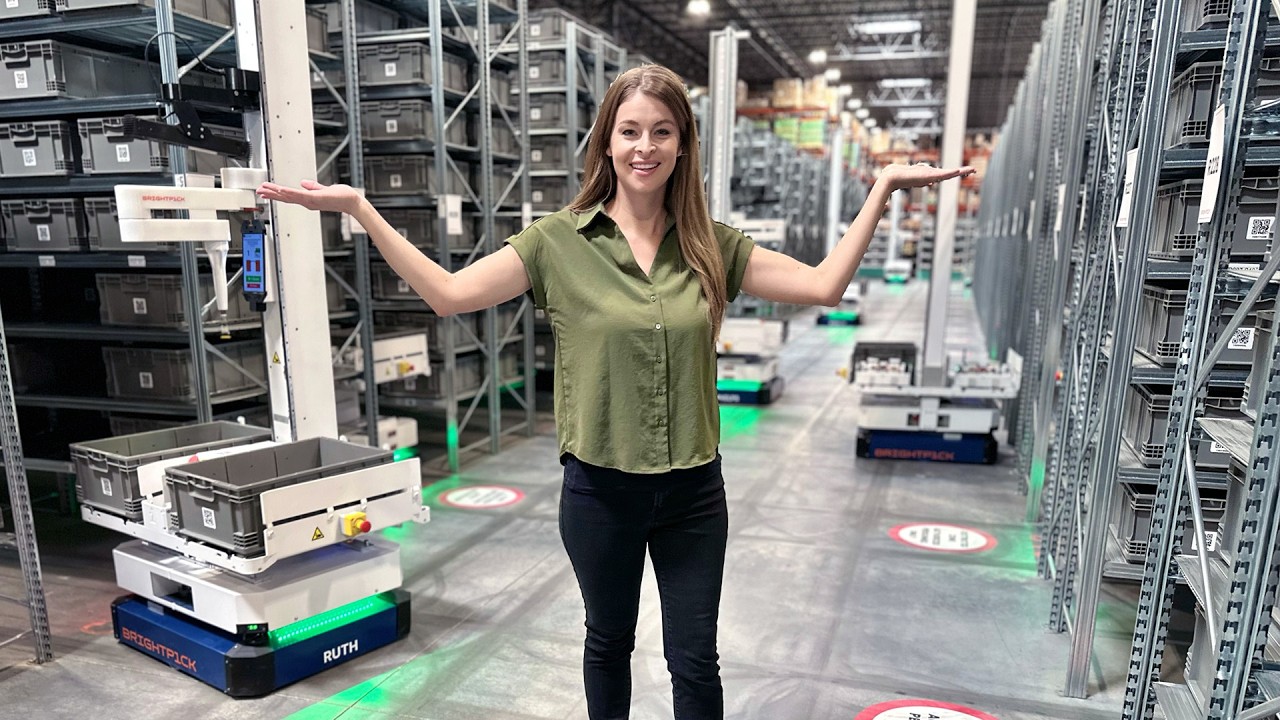 10:26 Robotics and Factory Automation
Inside an AI-run robotic warehouse
A fleet of autonomous mobile robots carries totes to picking stations while robotic arms take the individual items out. Nothing in the building waits for a person to walk anywhere. Brightpick built this to show order fulfilment with no human in the movement loop at all, and the choreography is genuinely unsettling to watch.
-
 4:18 Robotics and Factory Automation
Case-handling robots running a whole distribution center
Symbotic replaces the pallet rack and the forklift with autonomous bots that run the full height and depth of the structure at speed. Cases are broken down, stored individually and rebuilt into store-ready pallets in the exact order a shelf stocker wants them. Watching a pallet get assembled to a floor plan is a strange kind of satisfying.
-
 4:05 Robotics and Factory Automation
A robot sewing a car seat cover
A robot arm feeding fabric through a sewing head sounds impossible, because cloth does not hold its shape. KUKA solved it by making the robot the feeder and the needle the fixed point, and the seat cover comes out straight. Anyone who has tried to automate soft goods will understand exactly how hard this is.
-
 4:00 Robotics and Factory Automation
Inside a robotic arc welding cell
A turnkey arc welding cell where a positioner rotates the part while the robot lays a bead, then flips to the second station so the operator loads while the robot keeps welding. Zero idle arc time is the whole point. Yaskawa walks through the layout clearly enough that a shop owner can see their own parts in it.
-
 3:44 Robotics and Factory Automation
A robot tending a CNC machine on its own
A collaborative robot loads and unloads a CNC machine all night with no fence, no light curtain and no operator standing by. Universal Robots put real numbers on it: lower cost per part and materially higher throughput. It is the most credible small-shop automation case study on YouTube.
-
 3:27 Robotics and Factory Automation
A warehouse stacked into a solid cube of bins
AutoStore deletes the aisles. Bins are stacked directly on top of each other in a solid aluminum cube and robots drive across the roof, digging down for whatever is needed. The result is roughly four times the storage in the same building, which is why the system spread from Norway to warehouses on every continent.
Looking for one of these?
Robots, palletizers, case packers, conveyors, end of line equipment and complete packaging cells. APE buys and sells them. Tell us what the line has to do.
American Plant & Equipment has been buying and selling industrial machinery out of Roebuck, South Carolina since 1975, with 97,000 machines in inventory. Tell us the process you need to run and we will go and find the machine, or we will move the one you are finished with.
Prefer to talk? Call (864) 574-0404 or email sales@americanplantandequipment.com.