All machines Machines Tunnel Boring Machines
Giant Machines
Tunnel Boring Machines
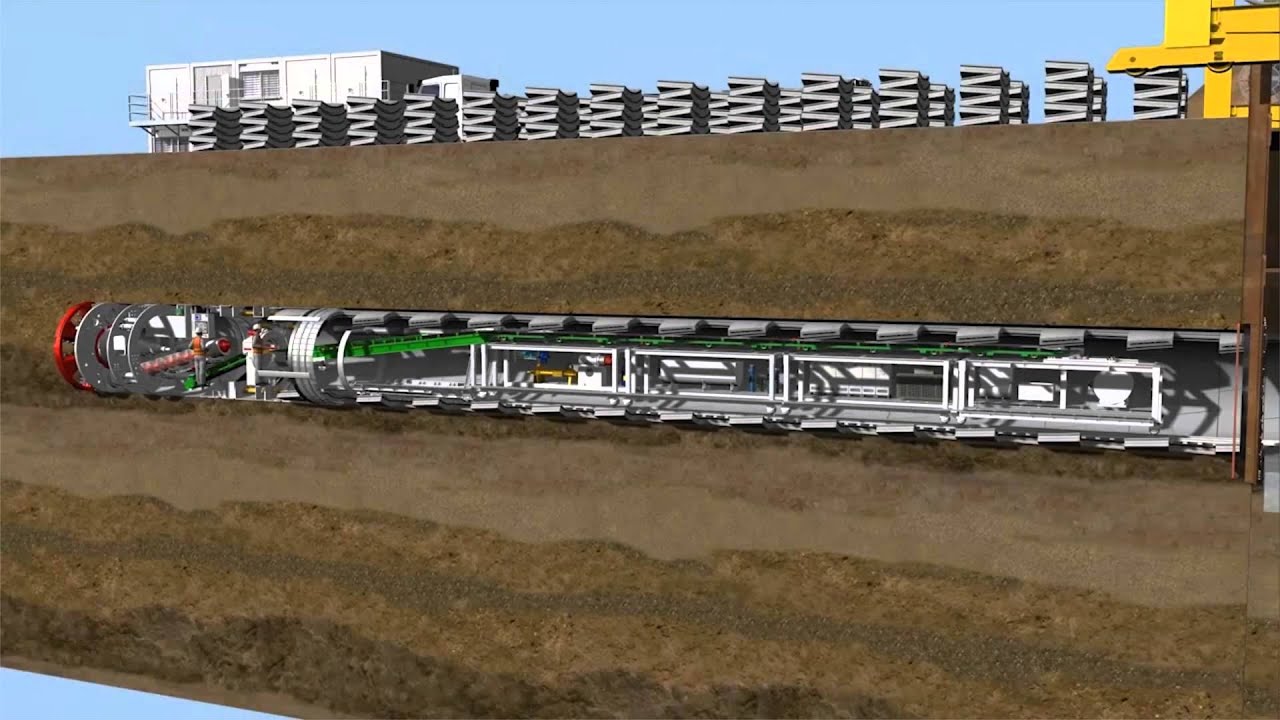 8:46
8:46 A tunnel borer building its own concrete lining behind it. Filmed and published by Herrenknecht AG. Plays from YouTube, nothing here is re-hosted.
What it does
A tunnel boring machine digs a tunnel and builds it at the same time. It is not a drill. It is a mobile factory a couple of hundred meters long that eats ground at the front, processes the spoil down its length, erects a finished concrete tunnel lining behind itself, and pushes off that lining to move forward.
How it works
A rotating cutterhead studded with disc cutters or cutting teeth presses against the face. In soft, wet, urban ground an earth pressure balance machine keeps the excavated soil itself pressurized in a chamber behind the cutterhead, so the pressure in that chamber balances the groundwater and earth pressure outside and the street above does not settle. A screw conveyor meters the spoil out of that chamber, and the discharge rate of that screw is how the operator controls face pressure. Hard rock machines do the opposite: they grip the tunnel walls with hydraulic pads and shove the cutterhead into solid stone, where the discs crush the rock into chips rather than cutting it. Behind the shield, an erector arm swings precast concrete segments into a ring and bolts them together. The thrust rams then push against that completed ring to advance, and the cycle repeats.
The numbers
Earth pressure balance machines are built in diameters from roughly 3.5 meters up to about 17.6 meters, which is the largest diameter we can confirm has actually been delivered and driven. Larger diameters appear in manufacturer proposals rather than in finished tunnels. A mid-size metro machine at around 6.8 meters diameter runs roughly 120 meters long and weighs about 1,100 tonnes complete with backup gantries. Cutterheads are transported as single pieces on multi-axle trailers and become minor news events when they move.
Who uses one
Metro authorities, water and sewer utilities, road and rail projects, hydroelectric schemes and mining shaft contractors. Machines are frequently specified for one project, built to that geology, and then refurbished for the next.
More giant machines
See the whole category-
 26:04 Giant Machines
How a walking dragline works
Twenty-six minutes inside one of the largest machines on earth, walking the house, the motors, the drum room and the operator's chair. Earthmovers Media explains why a dragline uses drag and hoist ropes instead of hydraulics, and what happens when a rope lets go. The best long-form dragline explainer available.
-
 45:06 Giant Machines
The bucket wheel excavator, the largest machine that moves on land
A full-length documentary on the bucket wheel excavator, the largest land vehicle humanity has ever built. The Bagger 293 weighs about 14,200 tons, stands 96 meters tall and can move 240,000 cubic meters of earth in a day. Forty-five minutes of engineering that reads like science fiction but has been running in German lignite mines for decades.
-
 14:41 Giant Machines
Monster mining machines: draglines up close
A dragline is a crane the size of an office block that throws a bucket, drags it through the earth and swings a hundred tons of overburden in one pass. BuildWitt films from inside the house and up on the boom, so you finally get a sense of the physical scale. The machine walks on shoes rather than tracks because nothing else could carry it.
-
 12:48 Giant Machines
America's iron giants, the most powerful metalworkers ever built
The United States Air Force built a set of forging presses in the 1950s so large that seventy years later they are still doing work no other machines can do. One squeezes with 50,000 tons of force. Machine Thinking tells the story with archive footage and real engineering, and the scale never stops being absurd.
-
 9:19 Giant Machines
A shaft sinking machine digging straight down
Herrenknecht built a machine that sinks a vertical shaft from the surface downward, underwater, with nobody down the hole. The cutting head hangs below the shaft lining and grinds its way down while the lining follows it. It solves a problem that used to kill people regularly, and it is beautifully explained.
-
 8:51 Giant Machines
How a hard rock tunnel boring machine cuts stone
Hard rock TBMs chew through solid stone using disc cutters that crush rather than cut, gripping the tunnel walls to shove themselves forward. Herrenknecht shows the cutterhead, the grippers and the back-up gantries as one continuous underground factory. Machines in this family run in diameters up to roughly 19 meters.
-
 8:40 Giant Machines
Riding a 14.5 million pound dragline
A ride along on a working dragline that weighs 14.5 million pounds, filmed by someone who actually runs it rather than by a film crew. You hear the drums, feel the swing and watch the bucket come back full. The unpolished first-person view is exactly what makes it worth watching.
-
 5:45 Giant Machines
Why the world's largest land vehicle exists
A crisp, funny explanation of why anyone would build a 14,000 ton machine that moves at one tenth of a mile per hour. The answer is that continuous excavation beats truck and shovel when the material is soft and the volume is enormous. Good context to pair with the raw footage clips.
Looking for one of these?
APE does not trade tunnel boring machines. What we do trade is the plant that works around one: cranes, compressors, generators, pumps, conveyors, segment handling and shop equipment. Tell us what the job needs.
American Plant & Equipment has been buying and selling industrial machinery out of Roebuck, South Carolina since 1975, with 97,000 machines in inventory. Tell us the process you need to run and we will go and find the machine, or we will move the one you are finished with.
Prefer to talk? Call (864) 574-0404 or email sales@americanplantandequipment.com.