All machines Machines Mattress Quilting Lines
Textile and Bedding Automation
Mattress Quilting Lines
 1:50
1:50 Multi-needle quilting with automatic hemming. Filmed and published by MPT Group Ltd. Plays from YouTube, nothing here is re-hosted.
What it does
Quilting is what turns flat ticking fabric and loose foam or fiber into the padded panel that becomes the top, bottom and border of a mattress. It is not decoration. The stitch pattern controls how the fill is held in place, how the surface feels, how the panel wears, and how fast the whole factory can run, because every other machine in a mattress plant waits on the quilter.
How it works
Fabric, foam and backing are unrolled together and fed as a sandwich under a needle bar. A multi-needle machine carries a row of needles across the full width of the panel and moves the fabric under them in two axes to trace a programmed pattern, usually with a chainstitch because it tolerates the fill thickness. Because the needles are fixed and the fabric moves, pattern complexity costs nothing in mechanical terms. The quilted web then runs into an inline panel cutter that measures and cuts to size, and often into an automatic hemming or serging station that finishes the edge before the panels are stacked. The whole run can go from raw roll to stacked, sized, hemmed panels with one operator supervising.
The numbers
Multi-head machines with independently driven sewing heads can run heads at speeds in the region of 1,400 rpm. High-speed fixed-needle machines take a different route: putting sixteen needles in a tight arrangement shortens the thread path dramatically and roughly doubles the sewing speed of a conventional mattress quilter. Downstream, roll packing machines compress a finished mattress by up to about 90 percent of its volume on a 30 to 40 second cycle, at rates around 60 pieces an hour.
Who uses one
Mattress manufacturers, bedding and topper producers, furniture and upholstery plants, and technical textile converters.
More textile and bedding automation
See the whole category-
 0:56 Textile and Bedding Automation
An air jet loom running at 2,015 rpm
An air jet loom firing weft yarn across the fabric with a pulse of compressed air, over two thousand times a minute. There is no shuttle and nothing mechanical crossing the warp. Machines in this family reach roughly 1,350 weft insertions per minute in production, and the sound alone is worth the fifty seconds.
-
 8:02 Textile and Bedding Automation
The robot revolution comes to garment sewing
The Wall Street Journal follows the attempt to automate garment sewing, including the machines that can do it and the reasons most factories still use people. It is honest about what works and what does not. The best available reporting on why cloth is so much harder than steel.
-
 6:02 Textile and Bedding Automation
An automatic sectional warper winding a beam
A sectional warper builds a beam of thousands of parallel yarns, each under identical tension, because any variation shows up as a fault in the finished fabric hundreds of meters later. Karl Mayer automated the whole sequence. It is one of the least known and most important machines in textiles.
-
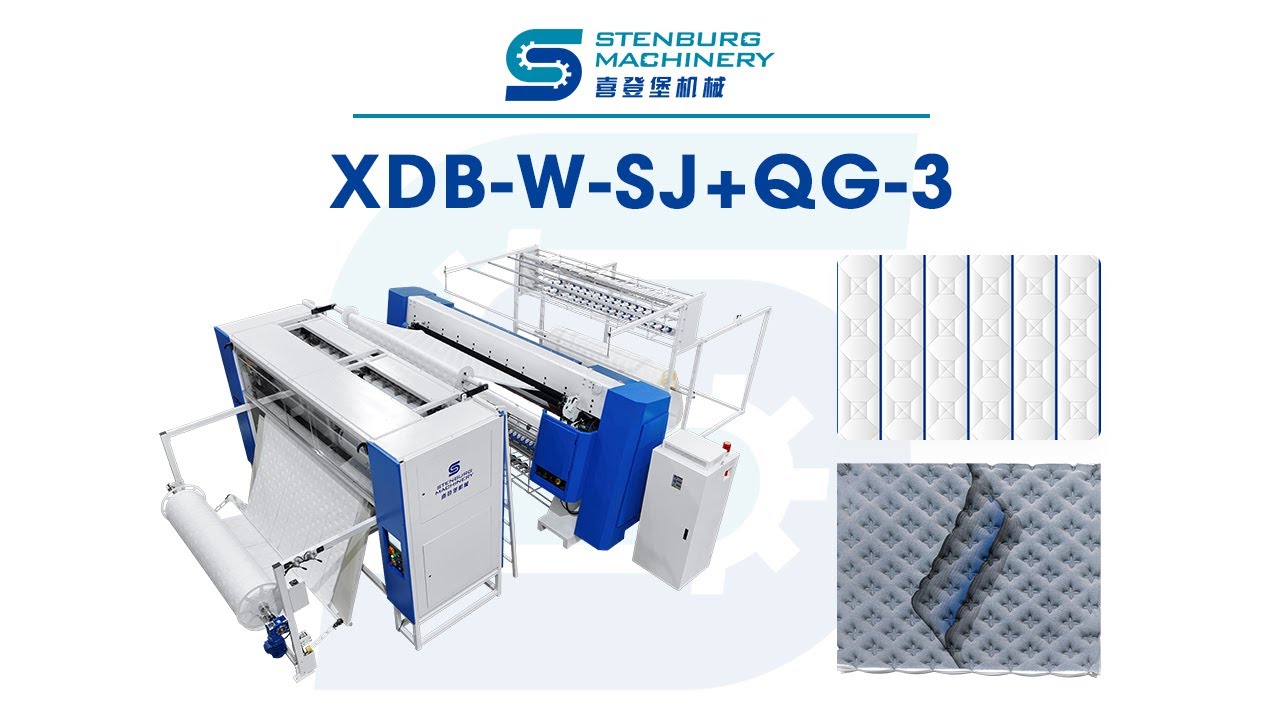 5:52 Textile and Bedding Automation
A multi-needle quilting machine with a panel cutter
A multi-needle quilter feeding straight into a panel cutter, so quilted fabric comes off the roll and leaves as stacked, sized mattress panels. Combining the two removes the buffer between them and a whole handling step. Six minutes of the exact machine combination that most mattress plants are built around.
-
 5:33 Textile and Bedding Automation
Panel quilting on a mattress quilter
A chainstitch panel quilter running a full pattern across the width of the fabric, with the needle bar tracking a programmed path. Panel quilting is where the look of a mattress is decided, and the machine has to hold the pattern over hundreds of meters of material. Five clear minutes of it working.
-
 5:13 Textile and Bedding Automation
New mattress machinery running on the show floor
A walk through a set of mattress machines from one of the best known names in bedding equipment: quilting, panel cutting, border work and closing. Seeing the machines in sequence explains how a mattress is actually built, which almost nobody outside the industry knows. Useful context for the individual machine clips.
-
 4:49 Textile and Bedding Automation
A rotor spinning machine turning fiber into yarn
A rotor spinning machine with 600 spinning positions, each rotor turning at up to about 148,000 rpm, and robots patrolling the length of the frame to repair broken ends automatically. Cotton goes in as sliver and comes out as wound yarn packages. It is a factory disguised as a single machine.
-
 3:34 Textile and Bedding Automation
A 16-head mattress quilter at speed
The V16 uses sixteen fixed needles in a tight arrangement that shortens the thread path dramatically, letting it sew far faster than a conventional mattress quilter. Speed in quilting is limited by thread management more than by motors. This is the machine that made that clear to the industry.
Looking for one of these?
This is APE's home ground. We buy and sell quilting machines, tape edge machines, spring machinery and complete mattress lines. Tell us what you are looking for or what you want to sell.
American Plant & Equipment has been buying and selling industrial machinery out of Roebuck, South Carolina since 1975, with 97,000 machines in inventory. Tell us the process you need to run and we will go and find the machine, or we will move the one you are finished with.
Prefer to talk? Call (864) 574-0404 or email sales@americanplantandequipment.com.